Living land acknowledgement
KUMEYAAY
Kumeyaay (Iipay and Tipai; Diegueño), Luiseño (‘Atáaxum; Payómkawichum), Cupeño (Ataxem; Kuupangaxwichem), and Cahuilla (‘Ivilyúatem) matt nyewa, San Diego. Haasilly, Matt Kwa’tay, Matsay.
Nyepily pii nyeway, mat meyuy supirr.
ENGLISH TRANSLATION
San Diego County is home to Kumeyaay, Luiseño, Cupeño, and Cahuilla people whose identities remain connected to the ocean, mountains, and desert. May this living land acknowledgement honor our shared commitment to Tribal and County relationships for a stronger future.
From ceremony to legacy: the permanent Tribal land acknowledgement art installation
The Tribal land acknowledgement art installation includes three elements: a single unified Tribal Nations flag; an art wall designed by the Southern California Tribal Chairmen’s Association (SCTCA), and an educational plaque co‑designed with Jamul tribal elders.
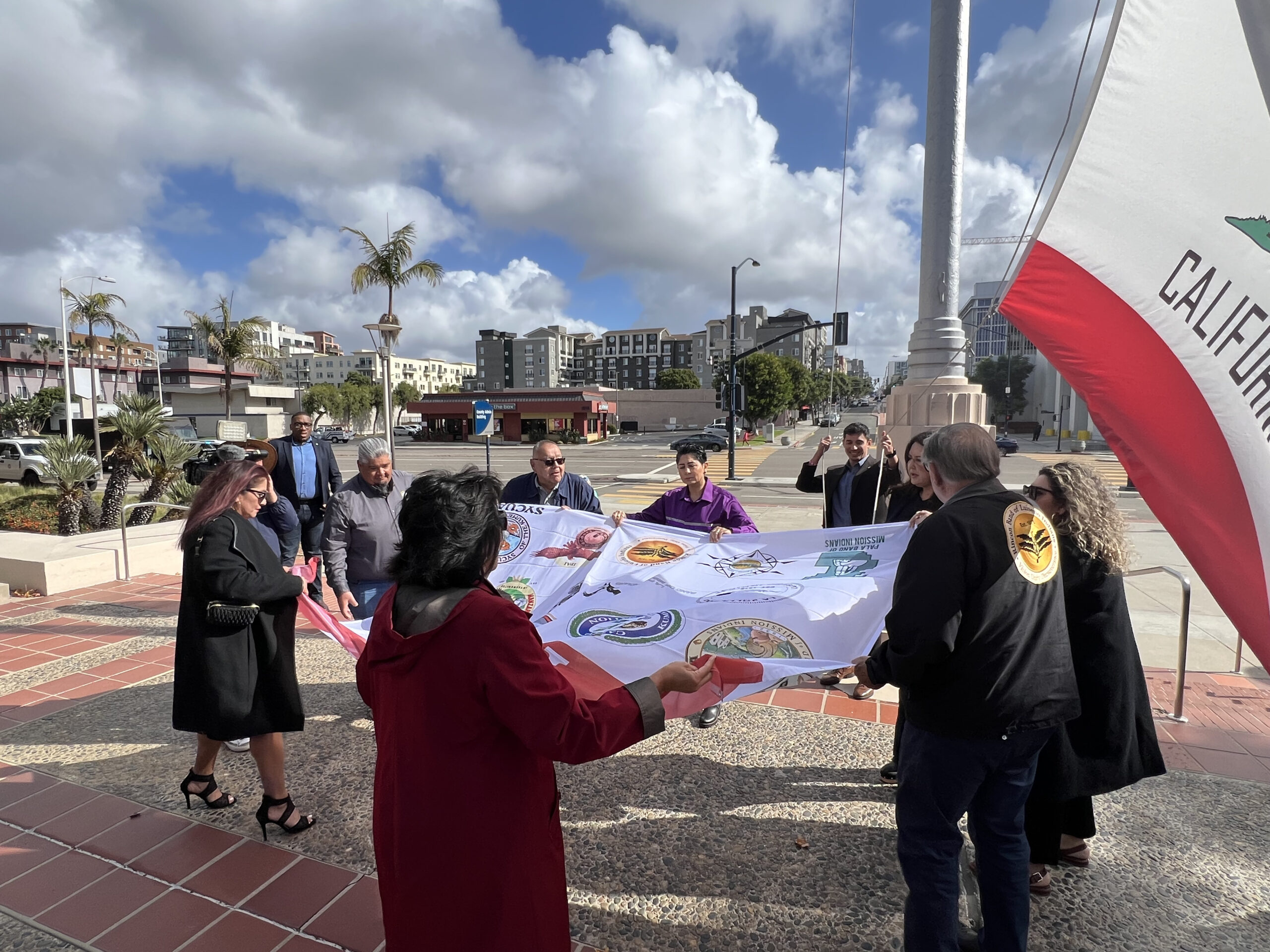
Unified Tribal Nations flag: As part of the County’s second annual ceremony honoring Native American Heritage Month in 2024, SCTCA proudly unveiled a single unified Tribal Nations flag featuring all 17 Tribal government seals, representing the 18 federally recognized Tribal Nations in San Diego County. This was the first time that all San Diego Tribes were represented on one flag. Before it was installed in its permanent location, the County flew the unified Tribal flag year-round on the County Administration Center’s main flagpole to reaffirm our commitment to meaningful collaboration.
Art wall: The striking curved concrete art wall stands as a visual tribute to the stories, traditions, and enduring presence of local Tribal Nations. Filled with rich symbolic imagery, the artwork offers a powerful reminder of the lands’ original stewards and their continued influence throughout the region. The artwork reflects the deep connection Kumeyaay (Iipay and Tipai; Diegueño), Luiseño (‘Atáaxum; Payómkawichum), Cupeño (Ataxem; Kuupangaxwichem), and Cahuilla (‘Ivilyúatem) maintain with the land, water, and sky, and honors the lifeways that continue to sustain tribal communities today. At the heart of the piece is a visual story of living in balance—depicting traditional practices such as traveling in a tule boat, weaving baskets, shaping pottery, and offering ceremonial song. These lifeways are shown alongside cultural elements essential to local Indigenous identity and teachings: the tobacco plant, the sun and moon, the oak tree, the eagle, and traditional sky knowledge passed down through generations. Because the figures are silhouettes, they do not reveal whether the people are wearing traditional regalia or modern clothing, emphasizing that these lifeways are not only part of the past, but continue to be practiced by Kumeyaay, Luiseño, Cupeño, and Cahuilla people today and into the future.
Educational plaque: Signage adjacent to the flag and art wall contains the language of the Living Land Acknowledgement, list of federally recognized Tribes in the region, and a QR code for visitors to learn more about County and Tribes’ government-to-government relationships and shared initiatives.

Tribal Land Acknowledgement Dedication Ceremony: November 12, 2026
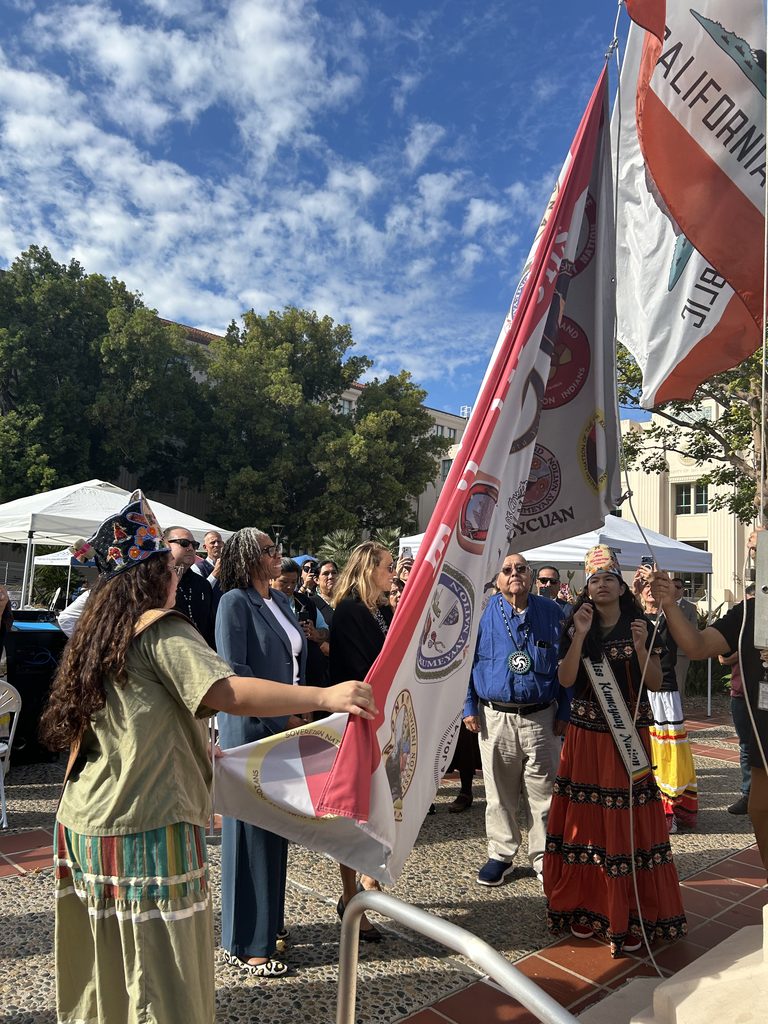
The County Administration Center’s north plaza was transformed into a dynamic gathering space as community members and tribal partners came together for a defining moment in San Diego County’s history. As part of the 4th annual County Tribal Land Acknowledgment Ceremony (formerly the Tribal Flag Ceremony), Chair Terra Lawson-Remer and Chair Pro Tem Paloma Aguirre joined the SCTCA to celebrate the permanent installation of the unified Tribal Nations flag at the County Administration Center—an enduring symbol of recognition, respect, and relationship.
The ceremony placed a strong emphasis on permanence and collaboration, celebrating the deep cultural roots of the region’s first peoples and the County’s ongoing commitment to strengthening relationships with Tribal Nations.
As part of the ceremony, Tribal organizations hosted learning stations to share information about their work in Tribal communities and engage directly with the public. Youth from the All‑Tribes American Indian Charter School brought excitement and energy to the event, underscoring the ceremony’s forward‑looking spirit and the importance of educating and empowering the next generation.
As the unified Tribal Nations flag was permanently planted, the moment marked far more than a ceremonial gesture. It served as a powerful symbol of remembrance, acknowledgment, and collective promise to honor sovereignty, uphold cultural heritage, and continue building a stronger, more connected future for all communities across San Diego County.
A History of Tribal Flag Ceremonies at the County
The tradition started with a sincere request from Jamul Indian Village Chairwoman Erica Marie Pinto, who encouraged the County to create space for Tribal Nations to raise their flags at the County Administration Center—a gesture to broaden cultural awareness and honor the original people of the region.
November 13, 2023, marked a historic milestone for the County of San Diego and local Tribal Nations. In partnership, former San Diego County Board Chair Nora Vargas and the SCTCA co-hosted the County’s first Tribal Nations Flag Ceremony during Native American Heritage Month. Leaders from both the County and Tribal Nations gathered in unity to honor the original stewards of the land, recognize the region’s shared history, and celebrate the County’s commitment to listening, learning, and working collaboratively with Tribal Nations to strengthen respectful, meaningful government-to-government relationships across the region. SCTCA displayed four ceremonial flags representing the Kumeyaay, Luiseño, Cupeño, and Cahuilla cultural Nations.
During the ceremony, late Chairman Bo Mazzetti of the Rincon Band of Luiseño Indians and Chairwoman Erica Marie Pinto spoke on behalf of the SCTCA, while Supervisor Nora Vargas and Supervisor Joel Anderson offered remarks on behalf of the County. Traditional Luiseño and Cahuilla bird singers and dancers shared songs that carry cultural meaning and generational memory. District Attorney Summer Stephan attended, and Assessor Recorder County Clerk Jordan Marks presented certificates of appreciation to each Tribal Nation—recognition that underscored the significance and shared joy of the moment.
This inaugural event sparked a legacy that continues to grow. Every year since, the County has upheld this annual celebration during Native American Heritage Month:
- In 2024, more than a dozen Tribal leaders joined former Supervisor Nora Vargas and Chief Administrative Officer Ebon Shelton for the ceremony.
- In 2025, Chairwoman Erica Pinto of the Jamul Indian Village, Chairman Robert Smith of the Pala Band of Mission Indians, Miss Kumeyaay, and Little Miss Kumeyaay joined County Board Chair Terra Lawson-Remer and Vice Chair Monica Montgomery Steppe as speakers.
- Tribal-serving organizations, County departments, and the County’s Indigenous Sovereign Nations Employee Resource Group hosted tables to share information, build connections, and encourage collaboration.
- The ceremony also featured bird songs from James Cuero of the Jamul Indian Village and Wayne Nelson of the Pala Band of Mission Indians, whose traditional songs brought cultural depth and continuity to the gathering.
