




2025 Strategic Research Plan Development
On May 18, 2021, the San Diego County Board of Supervisors voted to launch a comprehensive approach to evidence-based policy making and to establish an Office of Evaluation, Performance, and Analytics (OEPA). This action instructed OEPA to develop an Annual Strategic Research Plan (Plan) designed to: identify the most important research and policy questions, key service areas, and program models on which to focus evaluation efforts; and be incorporated into the County's annual strategic planning process. The Plan was first developed in 2023 and this is the first update. The Annual Strategic Research Plan will continue to be updated regularly to identify how the past year’s research and evaluation efforts have forwarded the Plan—and to ensure the Plan and its goals continue to be aligned with key administrative priorities. The 2025 update process accomplished the following goals:
- Assess how well the 2023 Strategic Research Plan is meeting County leadership priorities.
- Identify progress made on learning agenda questions.
- Update the Plan to strengthen alignment with the County Strategic Plan.
- Build shared understanding of and buy in for learning priorities across County groups and other relevant parties.
- Prioritize Learning Agenda questions that will guide the upcoming years’ activities.
- Focus the Learning Agenda, narrowing from 33 questions in 2023 to less than 20 in 2025.
Process
OEPA designed a process to achieve the goals outlined above and to develop and revise the Annual Strategic Research Plan between July 2024 and May 2025. This cycle will be repeated annually to ensure the Plan remains timely, collaborative and useful for helping guide County decisions. The process follows a recurring cycle designed to keep the plan relevant and ensure it produces data and evidence that decision-makers can use to take actions to improve services and programs.
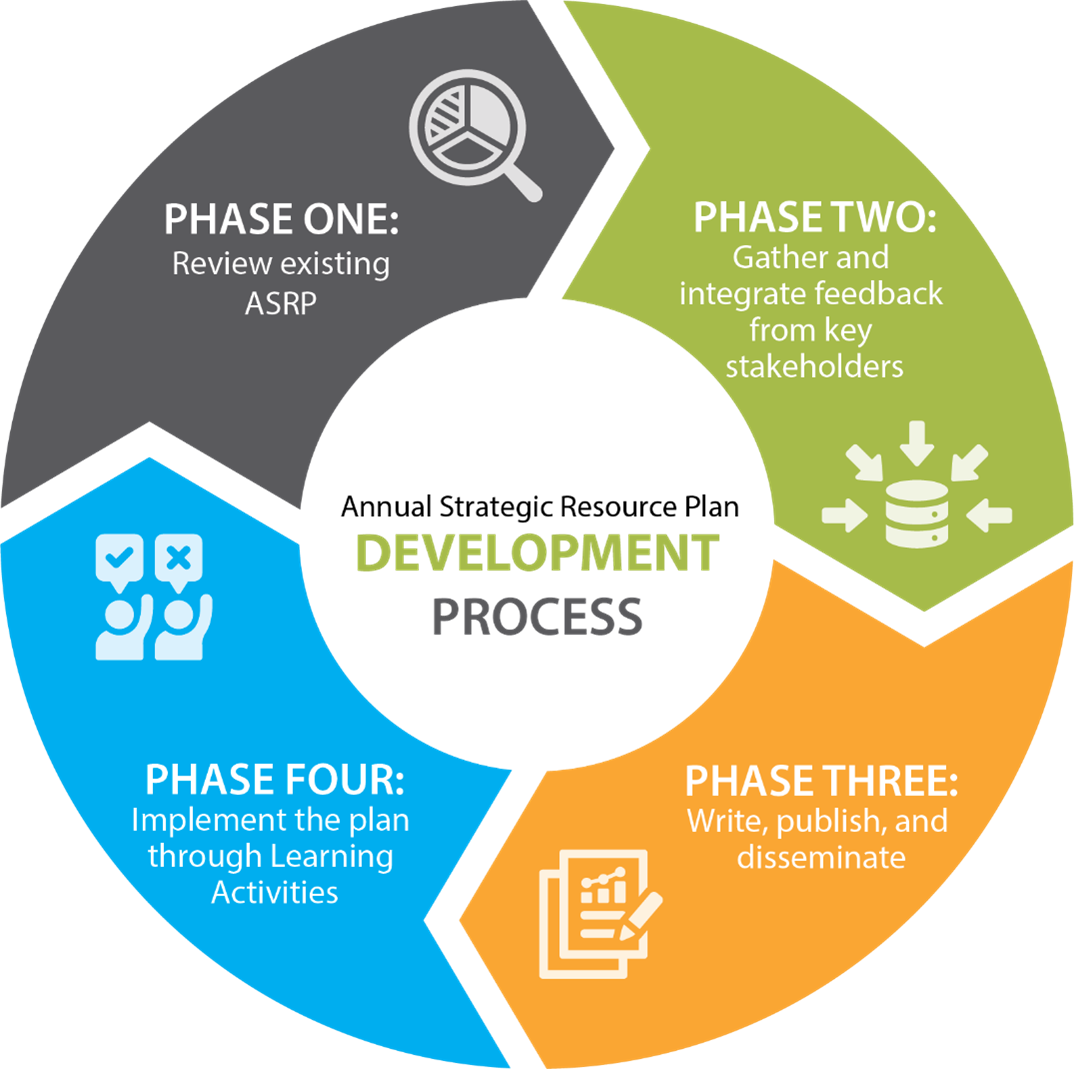
Phase One: OEPA reviews the existing Learning Agenda to assess if it continues to be relevant and aligned with the County’s Strategic Plan, and that it identifies key stakeholders to involve in the update process.
Phase Two: OEPA engages both County departments and public stakeholders to refine existing Learning Agenda questions, propose new ones, and prioritize a focused set for the updated Plan.
Phase Three: Using this input and additional feedback from County leadership, OEPA drafts and publishes the Plan.
Phase Four: OEPA and other County departments design and carry out Learning Activities - evaluations, projects and studies - designed to answer the prioritized Learning Agenda questions.
County Stakeholder Engagement
The Annual Strategic Research Plan was developed through an iterative process, led by OEPA and with input from key stakeholders. County leadership; the Strategic Advisory, Guidance, and Evaluation (SAGE) team; departments; and the public were engaged. They provided input and feedback on the questions, criteria for inclusion, and overall priorities for evaluation at the County.
Departments
Departments reviewed existing Learning Agenda questions that aligned with their work. For each question, departments answered the following questions:
- How would the information from answering this question be used by your department?
- For this information to be useful, when would you need the answer to the question?
- Is there a specific program or effort that this information would inform or advance?
- Who is invested in this question being answered (Board of Supervisors, Chief Administrative Office, Department Leaders, Program Managers, the Public, etc.)
- Is there any additional information needed for leadership to accurately consider this Learning Agenda question?
Departments also had the opportunity to propose new Learning Agenda questions.
Strategic Advisory, Guidance, and Evaluation (SAGE)
SAGE is an advisory team comprised of senior staff from across the County government. Members provided guidance on what criteria should determine which questions to include in the Annual Strategic Research Plan. OEPA facilitated a virtual workshop with SAGE, which led to four main criteria that were used to select questions for the 2025 Plan:
- Alignment with public input.
- Focus on resource efficiency.
- Consistency with the Board of Supervisors' priorities.
- Potential to inform key decisions.
SAGE could also propose new questions on high priority topics not already included in the Learning Agenda and provide feedback on the Plan.
Business Group Managers and Chief Administrative Office
County leadership, including SAGE, Business Group Managers, and the Chief Administrative Office, provided feedback on and final approval of the Plan.
Office of Evaluation, Performance, and Analytics (OEPA)
In addition to facilitating the development process, OEPA assessed the technical feasibility of answering the Learning Agenda questions and led the writing of the Plan.
Public Engagement
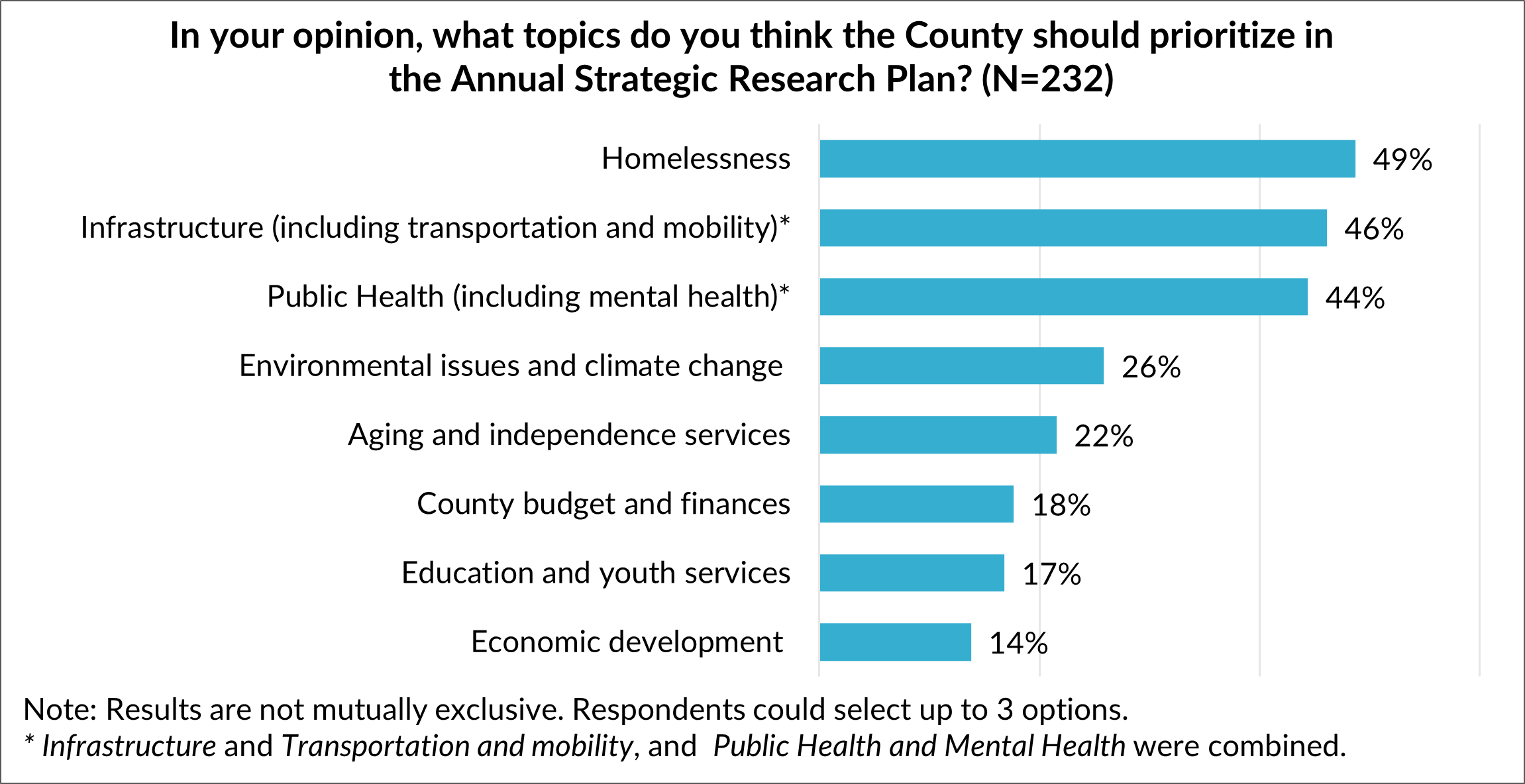
Between Jan. 9, 2025 and March 10, 2025, 232 people from 15 of 18 incorporated cities and the unincorporated area responded to the Annual Strategic Research Plan survey through the Engage San Diego website. The results of this survey informed the update of the Plan to ensure that the public’s highest priorities are represented in the questions that will guide research and evaluation in upcoming years.
The survey was publicized through County social media accounts, the County Library website, listservs, and in person at meetings. Most respondents were residents of the City of San Diego (42%) and the unincorporated area (21%).
People surveyed reported their highest priority policy areas as: Homelessness (49%), Infrastructure (46%), and Public Health, including Mental Health (44%).
In open-ended comments, respondents provided additional research suggestions, such as the following ideas:
- How to improve mental health services, reduce substance abuse, and understand environmental factors that impact health.
- How to ensure that County resources are used efficiently and effectively to reduce unnecessary spending.
When asked how the County should decide what to research, the top reasons people surveyed gave were: to better understand the community’s needs (65%), to improve programs and services (57%), to support data-driven decision making (46%), and to create accountability (42%).
OEPA will provide opportunities for the public to learn about research being done at the County through our website, GovDelivery email listserv, and other County channels.


 Helpful Links