




Alternatives to Incarceration Work Plan
The Alternatives to Incarceration (ATI) work plan progress describes efforts by the County of San Diego and regional partners to implement new programs and services across many stages of the criminal legal and justice systems.
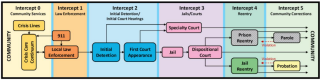
Diagram of the Sequential Intercept Model showing six intercept points along the criminal justice continuum: (0) Community Services, (1) Law Enforcement, (2) Initial Detention and Court Hearings, (3) Jails and Courts, (4) Reentry, and (5) Community Corrections. Each intercept represents opportunities to divert individuals with behavioral health needs away from deeper involvement in the criminal legal system.
ATI work plan actions follow a sequential intercept framework (Sequential Intercept Model, or SIM). The SIM is a way to map out all the points where a person might come into contact with the criminal legal and justice system-from the very first moment of crisis all the way through reentry, when a person leaves jail or prison custody. At each "intercept" or step, communities and agencies look for opportunities to support people with services before they end up in justice involvement.
ATI accomplishments include the launch of a care coordination and case management program for people who quickly cycle in and out of jail, increased access to sobering services for public intoxication, and improved connections to housing from jail. The work plan also includes structural system improvements, such as actions to support peer workforce development and engage consultants with lived justice system experience in program design. The ATI work plan is based on an April 2023 San Diego Association of Governments (SANDAG) report that includeded over 50 recommendations for the County, as well asongoing collaborative stakeholder analysis of local system needs and opportunities.
Numeric data is generally reported through September 30, 2025, unless otherwise stated. The work plan is a living document, and actions have been added, updated, completed, or removed compared to the initial May 20, 2023, work plan and May 23, 2025, work plan actions presented to the Board of Supervisors. Past work plan items and results are archived. A collaborative ATI Advisory Group composed of community representatives and public agency health and justice parters monitors the progress of work plan actions and develop plans and recommendations for new actions.
Below are the current ATI work plan actions. To get more information on a specific item, click the title of the work plan.
ATI Work Plan Items

Instead of taking people to jail for low-level offenses or for being under the influence in public, a peace officer will bring them to a service hub. There, they will meet with a case manager who will help create a personalized plan for their needs – such as housing navigation, rehabilitation services, employment support, and more.

Sheriff’s Reentry will connect and transport clients directly to interim housing from custody.
Sheriff can refer individuals directly to interim housing placements once released from custody. Transportation is also provided.

Provide care coordination and housing services to individuals at early intercepts
Through a contracted partnership, individuals are provided intensive care coordination, individualized case management, and housing services for up to 12 months, with the goal of reducing justice involvement and increasing permanent housing placements.

Expand universal transportation, care coordination, and housing upon release from custody
Individuals who are released from a detention and reentry facility will have access to reliable transportation and resources to ensure a successful reentry to the community. This focuses on providing transit passes and information to assist individuals leaving jail. This item also focuses on creating new outreach and communication materials aimed at helping individuals access transportation, care coordination and housing services.

Update and reprocure Community Care Coordination (C3) and Housing programs
The Community Care Coordination (C3) programs provide long-term case management and housing services for justice-involved individuals who are at risk of experiencing homelessness. This item focuses on redesigning and reprocuring these services to ensure that they are sustainable and accessible to more justice-involved individuals.

Launch Resource and Reentry Hub and implement evaluation
Launch a 24/7 Resource and Reentry Hub (Hub) in the Central Region that has co-located services and basic needs assistance for justice-involved individuals.

Expand in-custody rehabilitative programming to high-level incarcerated persons
Expand voluntary rehabilitative services to high-level housing units to ensure a successful reentry to the community. This item includes access to Cognitive Behavior Therapy (CBT).

The Public Safety Executive Office will develop and co-host at least two regionalized and peer workforce events a year. These events are designed to promote career opportunities for individuals with lived experience.

Add housing-focused Correctional Counselors in County jails
The Sheriff's Office will dedicate a correctional counselor in each of the five detention and reentry facilities to identify homeless or at-risk individuals among populations that do not currently receive housing assessments and may be released quickly or at any point in their case.

Expand jail in-reach and transition services to additional populations with behavioral health needs
Jail in-reach services currently help people with serious mental illness prepare to return to the community by providing case management and connecting them to services after release. This action will expand those supports to also serve people with moderate and mild behavioral health needs.

Initiate Transitions Clinic Network Pilot(s)
Pilot up to two Transitions Clinics, which leverage individuals with lived justice experience to connect individuals leaving jails to a primary care doctor and clinic they can identify as their "medical home".

Launch employer and job-seeker outreach around the Fair Chance Hiring
Develop and implement an action plan to raise awareness of the California Fair Chance Act (FCA) of 2018 among local employers and help job seekers with prior convictions to know and assert their rights under the law.

Engage lived-experience experts as County consultants
Engage individuals with lived criminal legal system experience to help shape ATI programs and compensate them for their time and expertise.

Expand HCP Same Day Solutions Fairs
Explore funding and partnership opportunities to increase the number of HCP Same Day Solutions Fairs in the community and expand the resources offered at each event.

Enroll justice-involved individuals in benefits for which they are eligible for
Expand opportunities for justice-involved individuals to learn more about, be enrolled in, and receive self-sufficiency and health benefits they are entitled to, such as Medi-Cal and its expanded benefits under CalAIM, CalFresh, and CalWORKS.

County justice and health partners and the Regional Task Force on Homelessness will collaborate to develop permanent housing strategies for justice-impacted populations, with a goal of developing a housing plan that addresses the needs and challenges of justice-involved individuals.

Establish an ongoing structure for the ATI initiative
Develop and implement an ongoing Enterprise Structure that includes shared County leadership, an advisory group with public agency and community members, and a commitment to frequent broader community input.

County departments will work together to decide what to measure and how to track the impact of programs that offer alternatives to incarceration, including additional resources for those leaving custody and reentering the community.

Standardize and integrate justice system data elements for care coordination and system planning
The County is working across departments to improve how information is shared to better coordinate services for people involved in the justice system.


 ATI Resources