




Electric Vehicle
Charger
Program
Get funding to install EV chargers on private property in unincorporated San Diego County!
WHAT:
WHO:
FUNDING:
BONUS:
DEADLINE:
EV charger funding
Private property owners in unincorporated San Diego County
Up to $5,000 (L2) / Up to $75,000 (DCFC)
Extra for Equity Priority Areas
August, 25 2026
Program Overview
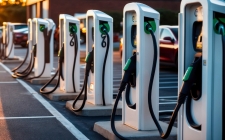
The Electric Vehicle Charger Program (EVCP) is a reimbursement-based program which incentivizes installation of Level 2 (L2) and DC fast charging (DCFC) chargers by reimbursing total equipment and installation expenses up to $5,000 for L2 chargers and $75,000 for DCFC before possible equity bonuses. Applicants must complete installation and submit documentation to receive funds by the applicable deadlines included in the EVCP Program Guidelines.
The program looks to expand access to publicly available EV charging infrastructure at key destination locations in the unincorporated area, advance equity by prioritizing underinvested communities, and support implementation of the County’s Climate Action Plan by facilitating EV adoption and reducing transportation-related greenhouse gas emissions.
Spread the word by passing along our EVCP flyer (English and Español) to interested partners and community members.
Incentives
Charger Type

Level 2 Charger

DC Fast Charger
(50 kW - 99kW)

DC Fast Charger
(100+ kW)
Base Rebate
$5,000 per charger or
75% of total project
costs,
whichever is less
$50,000 per charger or
75% of total project
costs,
whichever is less
$75,000 per charger or
75% of total project
costs,
whichever is less
Additional Rebates for Equity Priority Areas
Additional $1,000 per charger or 100% of
covered project
cost,
whichever is less
Additional $5,000 per charger or 100% of
covered project
cost,
whichever is less
Additional $10,000 per charger or 100% of
covered project
cost,
whichever is less
Maximum per Site
$30,000 (~6 chargers);
Increased to $36,000
in Equity Priority Areas
$225,000 (~4 chargers);
Increased to $255,000
in Equity Priority Areas
$225,000 (~3 chargers);
Increased to $255,000
in Equity Priority Areas
Rebates are capped based on total eligible project costs.
Equity Priority Area bonuses apply only to qualified
locations.
Projects with both L2 and DCFC chargers will use
the DCFC maximum rebate per location.
Eligibility
Who Qualifies: Applicants installing EV chargers on sites located on property under the County’s jurisdiction within unincorporated San Diego County, including retail parking lots, apartment complexes, multifamily (4+ units), office, retail, medical, school, faith-based, hospitality, industrial, and other easily accessible sites. Sites owned by Federal, State, or Tribal Governments are not eligible for the program.
-
Site Requirements
- Project sites must be located within the eligible area as shown on the EVCP Eligibility and Equity Priority Area Map
- Sites must be accessible to the general public for a minimum of 18 hours a day, except for multifamily properties (four or more units) which must be accessible to all tenants.
- See additional requirements in the EVCP Program Guidelines.
-
Key Dates
- Round 1 application window: June 25, 2026 to August 25, 2026
- Future rounds
- The County expects to have multiple rounds of incentives this year. Incentive amounts offered will decrease with each round.
- Sign up for email updates on the EVCP and other County sustainability initiatives.
How to Apply (Beginning June 25, 2026)
- Step 1: Check the eligibility of your project site on the EVCP Eligibility and Equity Priority Area Map.
- Step 2: Review the eligibility requirements in the EVCP Program Guidelines and EVCP Terms and Conditions.
- Step 3: Review the necessary application forms in the Resource Library.
- Step 4: Submit the EVCP Site Application Form and receive a Project Unique Identifier.
-
What Happens After Applying
- At the end of the funding round application period:
- If the funds are undersubscribed, all verified applicants will receive the incentive.
- If the funds are oversubscribed, a lottery will be used to select which projects receive funding.
- Once initial application materials are approved and projects are selected, the Program will provide an estimated incentive and reserve the funds.
- Selected applicants will be notified via email and will have three (3) weeks to formally accept or deny the incentive funds.
- Once a selected applicant officially accepts the funds, the applicant will have 270 days for L2 chargers and 450 days for DCFC to complete the project and submit all required documentation in the EVCP Final Requirements Form. See the Resource Library below for a full list of required documentation.
- Due to the cost and complexity of DCFC installation, EVCP provides a 50% milestone payment for these projects once applicants fill out the EVCP DCFC Milestone Requirements Form.
- At the end of the funding round application period:
-
Program Requirements
Installation Timelines
- Once the applicant officially accepts the funds, the applicant will have 270 days for L2 chargers and 450 days for DCFC to complete the project and submit all required documentation.
Data Sharing
- Data generated by the charging station must be shared with the County of San Diego and affiliated partners. Applicants are required to submit six (6) years of session/usage data for the EV charger(s). Data should be submitted at least every six (6) months, commencing after charger commissioning. Applicants must grant the County of San Diego and university research partners the right to directly acquire session/usage data directly from their network provider/operator, and network providers/operators must commit to timely provision of the session/usage data. Data should include at minimum: Station serial number, date and time of session start and conclusion, kWh of electricity consumed, and charger uptime statistics (see EVCP Terms and Conditions). Network providers/operators that already collect additional data identifying who initiated a session (e.g., a customer ID #, etc.) and/or the vehicle plugged in (make, model, and year) shall include such information.
- Your data may be linked to other information collected during the Program and to external data sources, solely for research purposes. No data will be used for enforcement, citations, residency verification, or any non-research purpose. All information will be given a unique identification number, stored securely, kept confidential, and combined with other data so that you will not be identified in any published results. Only authorized personnel will have access to the data. Data will be retained only for the duration of the study and then securely destroyed after 5 years.
- For a complete list of requirements, see the EVCP Terms and Conditions.
Maintenance (6 years, uptime, etc.)
- Applicants must commit to maintaining and operating all chargers for at least six (6) years after installation. This includes maintaining network connectivity, ensuring equipment functionality, and providing usage data as required by the County.
- Applicants must maintain a 97% uptime (ability to charge) during the six (6) year period as defined in the EVCP Terms and Conditions.
- Chargers must be publicly accessible 18 hours per day unless an overnight accessibility exception applies.
- For a complete list of requirements, see the EVCP Terms and Conditions.
- Resource Library
Frequently Asked Questions
-
Who can apply?
Applicants installing publicly accessible EV charging stations located on property under the County jurisdiction within unincorporated San Diego County may apply. Additional incentives are available for projects located in Equity Priority Areas and for eligible multifamily residential properties. The EVCP Eligibility and Equity Priority Area Map has been provided to identify overall site eligibility as well as Equity Priority Areas. Sites owned by Federal, State, or Tribal Governments are not eligible for the EVCP Program.
-
What is an Equity Priority Area?
Equity Priority Areas are made up of disadvantaged communities (DACs) and low-income communities (LICs) as defined by the California Environmental Protection Agency and Assembly Bill 1550, based on CalEnviroScreen 4.0 and the California Department of Housing and Community Development (HCD) income limits. Equity Priority Areas are also defined by the County of San Diego’s EV Roadmap which defined priority areas for charging infrastructure within the unincorporated area. Equity Priority Areas also include multifamily housing properties within unincorporated San Diego County.
-
What if funding runs out?
- At the end of the funding round application period:
- If the funds are undersubscribed, all verified applicants will receive the incentive.
- If the funds are oversubscribed, a lottery will be used to select which projects receive funding.
- The County of San Diego expects to have multiple rounds of incentives this year. Incentive amounts offered will decrease with each round.
- At the end of the funding round application period:
-
Can I apply for multiple sites?
- Although property owners may apply to this subsidy for multiple sites, a separate application must be submitted for each site. An application only applies to one project site.
- When applying, the property owner must disclose the unique identifier for all other submitted applications for this subsidy.
-
What happens if I miss deadlines?
- Applications will be automatically cancelled if the project surpasses the due date without a granted extension or if required documentation is incomplete or not submitted by the deadline.
- Projects may apply for an extension if the delay is due to factors outside the applicant’s control using the EVCP Extension and Cancellation Appeal Form (link).
- Projects may submit a cancellation appeal within 30 days of the cancellation date using the EVCP Extension and Cancellation Appeal Form (link).
Application Status
Please access your application status on the Jotform link sent to your email.
Have Questions?


 Climate Action Links