




Sustainable Operations in Land Stewardship Program (SOILS Program)
Project Contact: Amanda Appel | amanda.appel@sdcounty.ca.gov
Project
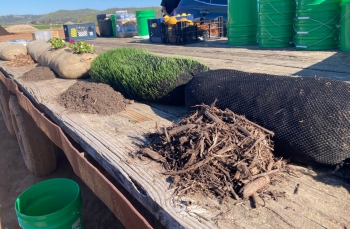
The County of San Diego Planning & Development Services is developing the Sustainable Operations in Land Stewardship Program (SOILS Program) to incentivize natural and working land practices that will help avoid and reduce greenhouse gas emissions in the unincorporated county. The SOILS Program, through stakeholder input and best practice research, will identify how the County can best support local land managers, ranchers, and agricultural producers in implementing different climate smart land practices such as compost application, hedgerow planting, and cover crop utilization. On September 11, 2024, the Board of Supervisors adopted the 2024 Climate Action Plan which includes the development of the SOILS Program (formerly known as the Pilot Carbon Farming Program). Below are current County resources that are relevant to the SOILS Program. Please continue to check this webpage to find out about more resources or sign up for email updates.
SOILS Pilot Program
In partnership with Zero Foodprint, the County is offering grants for farmers and ranchers looking to implement climate smart land practices in the unincorporated County. Two grant sizes will be awarded: $20,000 and $30,000. Projects involving a scope of work of 100 acres or more are eligible to apply for a $30k grant, and projects ranging from 1 to 100 acres are eligible to apply for a $20k grant. Eligible practices include hedgerow planting, compost application, range planting, and more.
*Please note that participation in the program is subject to availability.
Background

On January 13, 2021 (5), the Board of Supervisors directed staff to develop a Climate Action Plan (CAP) Update that meets and exceeds state mandates and establishes actions to meet a goal of net zero carbon emissions by 2035-2045. This direction requires the pursuit of all opportunities to reduce greenhouse gas (GHG) emissions as well as opportunities to sequester GHGs (i.e., remove and store GHGs that have already been emitted). The overall objective of the County’s Climate Action Plan (CAP) Update is to reduce GHG emissions generated from activities within the unincorporated county and by County facilities throughout the region. While most of the sectors in the CAP Update achieve GHG goals by reducing GHG emissions, the Agriculture and Conservation sector has the potential to both reduce and sequester GHGs through a myriad of practices referred to as carbon farming, regenerative agriculture, and/or climate smart land practices. To reach net zero it will be necessary to sequester GHG emissions which these techniques have the unique ability to do.
To advance work on the CAP Update, on August 31, 2022 (6), the Board of Supervisors directed staff to develop a Pilot Carbon Farming Program, now referred to as the Sustainable Operations in Land Stewardship (SOILS) Program, with options for program implementation, including identification of potential pilot sites. This direction was part of a larger effort to advance sustainability initiatives that support the County’s Regional Decarbonization Framework and will be considered as part of the CAP Update.
According to the California’s Natural and Working Lands Climate Smart Strategy, the term climate smart is used to “describe land management that delivers climate benefits through nature-based solutions”. Nature-based solutions refer to various methods aimed as conserving, managing, and restoring lands to address climate change and preserving biodiversity. Climate smart land practices, also referred to as carbon farming, can support the ability for plants and soils to remove carbon from the atmosphere and store it. Compost application or no tillage are practices that increase the amount of carbon the land and plants remove from the atmosphere. Beyond sequestering carbon, carbon farming also has the potential to improve soil health and produce other complementary benefits (co-benefits) such as increasing water retention in the soil, improving biodiversity, and increasing crop production.
Public Workshops
The County is committed to using public input and feedback to develop the SOILS Program. Announcements and recordings of public workshops will be made available here.
Subscribe to Project Updates
You can receive updates on the SOILS Program and other sustainability initiatives by signing up for email updates.


 Climate Action Links