




New World Screwworm
Page originally published on 12/3/2025. Last updated
7/15/2026.
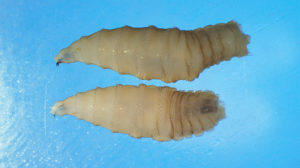
New World screwworm (NWS or Cochliomyia hominivorax) is a parasitic fly that lays eggs on and in open wounds. These eggs hatch into maggots that feed on the living tissue of warm-blooded animals and people. This can lead to serious health problems and death.
NWS is found in South America, Cuba, Haiti, and the Dominican Republic. For the first time in many years, countries in Central America and Mexico are seeing more cases in animals and people. As of June 2026, NWS was detected on the umbilical wound of a calf in Texas. In the last 10 years, there have been a few human cases in the United States, but all were due to travel in areas where NWS is commonly found.
NWS typically affects livestock, but can also affect wildlife, pets, and people. NWS is not common in people, but the risk goes up when traveling to areas where the flies are found. When traveling, you may be at a higher risk for NWS if you are in areas where the flies are found and:
- Have open sores or wounds, including from a recent surgery.
- Have a weakened immune system.
- Sleep outdoors, especially during the day.
- Live near or work with livestock or other warm-blooded animals.
On this page:
When traveling to areas where the NWS flies are found:

- Clean and cover open wounds.

- Wear loose-fitting, long-sleeved shirts and pants, and socks when outdoors.

- Sleep indoors (if the room has windows, the windows should be screened). If you are outside, sleep under a bed net or inside a screened tent.

- Use insect repellants.
Prevent NWS infestation in pets and livestock:
- Follow all animal importation and movement requirements.
- Prevent wounds and remove any sharp objects from an animal’s environment.
- Keep wounds clean, including the umbilicus on newborn animals. Monitor daily and treat as directed by a veterinarian.
- Ask a veterinarian about prevention and treatment for wound-causing parasites (ticks and fleas).
- Report any myiasis (maggots) cases to your veterinarian.
Follow all animal movement and importation guidelines to prevent spread of NWS to new locations.
- Before 1966, NWS was found in the United States. This caused major problems for cattle welfare and the economy.
- Since the mid-1960s, sterile flies have been released in areas where NWS is found. Doing so, creates a geographical biological barrier at the Darién Gap in Panama. This biological barrier helps stop the NWS fly from spreading north.
- However, since 2022, animal cases have spread as far north as Mexico,
- In September 2025, NWS was found in an 8-month-old calf less than 70 miles from the United States-Mexico border. This is the northernmost case of NWS since the outbreak in Central America and Mexico began.
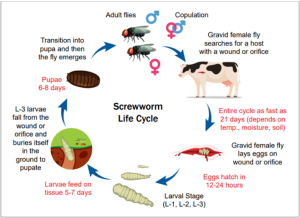
NWS infestations begin when:
- A female fly lays eggs on open wounds or other parts of the
body in live, warm-blooded animals.
- Wounds as small as a tick bite may attract a female fly to feed and lay her eggs.
- Eggs hatch into maggots that burrow into the wound to feed on the living flesh.
- After feeding, maggots drop to the ground, burrow into the soil, and emerge as adult screwworm flies.
Symptoms of NWS in People
NWS infestations are very painful. If you have an NWS infestation, you may see maggots around or in an open wound. They could also be in your nose, eyes, or mouth. Tell your healthcare provider if you have recently traveled to Central or South America, the Caribbean, or Mexico.
Symptoms can include:
- New or unexplained painful wounds or sores,
- Bleeding or drainage from open wounds or sores,
- Seeing or feeling maggots in a skin wound or sore, and
- Odor coming from an infestation site.
Bacteria can also infect wounds where NWS maggots are present. This may cause fever or chills.
Signs of NWS in Animals
- Irritated behavior,
- Uncontrollable headshaking,
- The smell of decay,
- Fly maggots in wounds, or
- Evidence of a myiasis (fly strike).
If you see or feel maggots in or on a wound or other area of your body, contact a healthcare provider right away.
- A healthcare provider will need to remove each maggot. You might need surgery for this.
- Do not try to remove any maggots or egg masses yourself. Do not throw any in the trash or outside. Doing so could make NWS spread in your area.
- If maggots or eggs do fall out of the wound, place them in a leak-proof container with rubbing alcohol. Bring the container to your healthcare provider.
Healthcare providers can diagnose NWS when they remove maggots from a patient and submit them to the County of San Diego Public Health Laboratory for testing.
- Healthcare providers should place all maggots directly into 70% ethanol (or other alcohol).
- When completing the Test Requisition Form, healthcare providers should select ‘Send-Out’ under the ‘Parasitology’ section, and specify ‘New World screwworm’.
There are no U.S. Food and Drug Administration (FDA) approved drugs for the treatment of NWS. FDA has put together a list of drugs that can be used when needed. FDA will continue to update the list as more information becomes available.
NWS in Animals
If you see maggots on an animal, contact a veterinarian. Animals with NWS should be treated by their veterinarian.
Veterinarians should:
- Remove all maggots from infested tissue,
- Place all maggots directly into 70% ethanol or isopropyl alcohol, and
- Report the case to the California Department of Food and Agriculture (CDFA) within 24 hours.
- Follow FDA treatment guidance.
Reporting
- Report all cases of suspected cases in PEOPLE to the San Diego County Epidemiology Unit right away. Call 619-692-8499 (8 am to 5 pm, Monday through Friday); 858-565-5255 (after hours and holidays).
- Report all suspected and known NWS cases in ANIMALS to the CDFA within 24 hours of discovery. CDFA will help coordinate samples for submission.
County of San Diego
- County Outlines Steps to Protect People, Animals from New World Screwworm (County News Center - July 2, 2026)
- One Health Epidemiology Program
Centers for Disease Control and Prevention
For Healthcare Providers
County of San Diego
-
CAHAN
San Diego Alerts
- Health Advisory Update #1: New World Screwworm Outbreak in Northern Mexico (January 23, 2026)
- Health Advisory: New World Screwworm Outbreak in Mexico and Central America (September 8, 2025)
California Department of Public Health
Centers for Disease Control and Prevention
For Veterinary Professionals
California Department of Agriculture (CDFA)
U.S. Department of Agriculture
Call the Epidemiology Unit at (619) 692-8499, or send an e-mail, for more information.


 Popular Services