




Module 9: School Site Best Practices

Best practices are key to ensuring smooth operations when SchooLink providers are on school campuses across different districts. Collaboration between providers and school staff is essential, and understanding each district’s specific requirements helps ensure compliance and access to students receiving services. Clear and frequent communication support a successful partnership.
Best Practices for Providers on School Sites
-
Follow the Unique School and District Policies
Understand and comply with each district's requirements for access, credentials, background checks, and documentation.
- Use the annual meeting as an opportunity to ask about the requirements for coming onto campus. (See Annual School Meeting, Module 3)
- Bring a photo ID
- Make contact with school staff before engaging students or parents/caregivers
- Make contact with school staff again, prior to leaving the school campus
-
Be Visible and Professional
Wear identification, follow dress codes, and conduct yourself professionally to foster trust with school communities.
-
Respect School Schedules and Environment
Coordinate sessions to minimize disruption to academic time and be mindful of school policies and routines.
Key School System Terminology
LEA (Local Educational Agency): a local entity that is involved in education, such as a school district, county office of education, or charter school.
IEP (Individualized Education Program): a plan that outlines the educational needs of a child with a disability.
504 Plan: a document that outlines how a school will support students with disabilities so they can participate in the general education curriculum.
SST: Student Study Team or Student Success Team, a group of educators, often including parents, that meet to develop a plan to support a student experiencing academic or behavioral challenges within the general education classroom to intervene early with strategies to help them succeed.
Multi-Tiered System of Supports (MTSS)
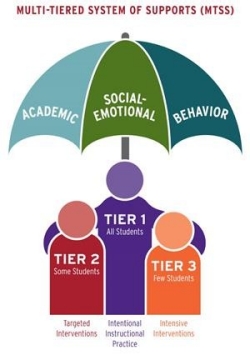
MTSS is an educational framework that provides academic and behavioral support to students by offering tiered levels of intervention based on individual needs:
- Tier 1 provides core instruction for all students
- Tier 2 provides targeted interventions for some students showing difficulties
- Tier 3 offers intensive support for few students requiring significant additional help
Positive Behavioral Intervention Supports (PBIS)
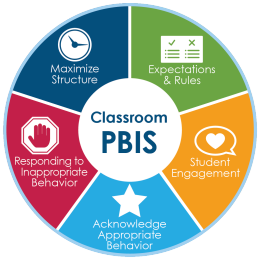
PBIS is a framework for supporting schoolwide practices to promote a safe school setting that supports the social, learning, behavioral, and emotional needs of all students. It includes five categories that research has linked to positive student outcomes:
- Maximize structure in the classroom with predictable routines and a safe, orderly environment
- Teach, monitor, and reinforce expectations and rules that are aligned to the school-wide expectations
- Actively engage students by providing contextually relevant instruction that includes high rates of opportunities to respond
- Use a continuum of contextually relevant strategies to acknowledge appropriate behavior
- Use a continuum of contextually relevant strategies to respond to inappropriate behavior
Source: Florida Positive Behavioral Interventions and Supports Project
Social Emotional Learning (SEL)
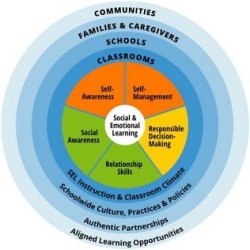
SEL is the process through which young people and adults acquire and apply the knowledge, skills, and attitudes that help us to understand ourselves, connect with others, achieve goals and support our communities.
The five Core Competencies include:
- Self awareness
- Self management
- Social awareness
- Relationship skills
- Decision making
Best Practices for School Site Personnel
-
Promote a Welcoming Environment
Greet providers, offer guidance as needed, and help them feel like part of the school community.
-
Know the Provider’s Role and Credentials
Ensure all providers are approved, background-checked, and clearly identified as authorized visitors.
-
Establish Clear Points of Contact
Designate a staff member (e.g., counselor or admin) as the provider’s main contact for coordination and support.
-
Maintain Student Confidentiality
Respect students' privacy and ensure that sessions occur in a confidential, distraction-free space.
Did you know?
School districts are governed by a school board, led by a superintendent and supported by San Diego County Office of Education. The schools operate under the umbrella of the district and led by a principal. Schools follow policies set by the district but may also have additional and unique practices for each particular school community – get to know the school community and culture. School administrators shift which makes the Annual Meeting a critical part of partnering with schools.
Did you know that in many schools the vice or assistant principal supports the principal and is often responsible for behavioral issues with students?
Resources
- San Diego County Office of Education (SDCOE) website. For more information on SDCOE, please visit Module 17.
- KEY RESOURCE: Supporting Students (SDCOE)
- County Behavioral Health Services’ School-Based Services offers an array of County resources and links to other sites
- Designed
for middle school and high school students, the Student
Wellness Resources webpage gives teens and young adults access
to resources that focus on promoting wellness and support. The
site offers an array of online and one-on-one interactive
resources that are free and can be accessed directly by students.
Some schools have placed a QR code on the back of student ID cards
that leads to this webpage (in response to CA SB1063 | 2023-2024)
Next Module


For administrative information or to provide feedback about the SchooLink training program, please email BHSContactUs.HHSA@sdcounty.ca.gov with subject line: SchooLink.
 Quick Links