




Automated External Defibrillator (AED)
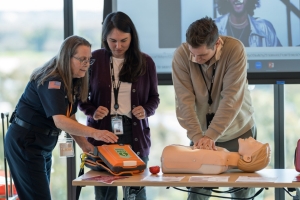
An AED, or automated external defibrillator, is a crucial device used in emergencies to assist individuals with sudden cardiac arrest. This portable unit monitors the heart's rhythm and, when necessary, administers an electric shock to restore normal heartbeat.
When acquiring an AED in San Diego County, it’s essential to register the device to comply with legal ownership requirements (refer to the Summary of Requirements below). Registering your AED online via PulsePoint not only fulfills legal obligations but also enhances public safety by aiding in life-saving efforts within the community.
PulsePoint AED allows both the public and emergency responders to quickly locate and access AEDs during critical situations, significantly increasing the likelihood of survival for someone experiencing sudden cardiac arrest.
Over 5,000 registered AEDs in San Diego County are mapped on the PulsePoint AED platform.
Register an AED


AED Requirements & Additional Resources
-
Summary of Requirements
SB 658 states that a person or entity that acquires an AED for emergency use is not liable for any civil damages resulting from the use of an AED to provide emergency care if that person or entity does all of the following:
(A) Comply with all regulations governing the placement of an AED.
(B) Notify an agent of the local EMS agency of the existence, location, and type of AED acquired.
(C) Ensure that the AED is maintained and tested according to the operation and maintenance guidelines set forth by the manufacturer.
(D) Ensure that the AED is tested at least biannually and after each use.
(E) Ensure that an inspection is made of all AEDs on the premises at least every 90 days for potential issues related to operability of the device, including a blinking light or other obvious defect that may suggest tampering or that another problem has arisen with the functionality of the AED.
(F) Ensure that records of the maintenance and testing required pursuant to this paragraph are maintained.
AED Owners may utilize the following checklist to ensure they have met the legal requirements:
-
Statutes & Regulations
Automatic External Defibrillators (General Requirements):
California Health and Safety Code, Sections 1714.21 and 1797.196
Building Requirements:
California Health and Safety Code, Section 19300
School Requirements:
California Education Code, Section 35179.4
California Education Code, Section 35179.6
California Education Code, Section 49417
California Education Code, Section 51225.6
Eric Paredes Sudden Cardiac Arrest Prevention Act
Health Studio Requirements (Gyms and Sports Clubs):
California Health and Safety Code, Section 104113
Public Pool Requirements:
California Health and Safety Code, Section 116045
-
Overview of PulsePoint AED
What is PulsePoint AED?
PulsePoint AED is a simple-to-use app that enables you to help build the public AED registry in your community - or anywhere. The County of San Diego utilizes PulsePoint as its AED registration platform.
AEDs that are managed using PulsePoint AED are accessible to emergency dispatchers and disclosed to emergency responders, including nearby citizens trained in CPR and off-duty professionals such as firefighters, paramedics, and nurses. Instead of asking the caller if there is an AED available, dispatch center staff can inform callers of nearby lifesaving devices.
There is never a charge to use any aspect of the PulsePoint registry. PulsePoint is a public, non-profit organization providing the app and hosted AED registry for free as part of its core mission to improve cardiac arrest survival. Let’s save some lives together.
Download the App now!


To register an AED and help save lives:
1-Download the FREE PulsePoint AED app
2-Create a FREE account with your email and password
3-To add an AED simply select the [+] at the bottom navigation and follow the steps
-
AED-CPR Educational Resources
CPR training is available at various levels from multiple sources. Your local fire agency or hospital can help you find the right course, ensuring it meets any job requirements.
The County’s EMS Section recommends “Hands-Only CPR” for all. This quick, life-saving training is easy to learn and most effective when paired with a public access defibrillator. Local fire agencies can often provide or direct you to available training.
These national organizations may be able assist you in finding a CPR class in your area:
American Red Cross - https://www.redcross.org/take-a-class/cpr
American Heart Association: https://cpr.heart.org/en/find-a-course
Thank you for your interest in starting a Public Access Defibrillation (PAD) program in San Diego County. Early defibrillation has been proven to save lives and improve outcomes for people who have experienced a sudden cardiac arrest. The County of San Diego EMS knows access to early defibrillation is essential for survival and encourages training in recognizing cardiac emergencies and using an Automated External Defibrillator (AED) to restore a normal heart rhythm.
For more information, email us or visit the California EMS Authority website.
 Popular Services