




Measles (Rubeola)
Page last updated 9/24/2026.
The County of San Diego is dedicated to preventing vaccine-preventable diseases by following the West Coast Health Alliance’s (WCHA) recommendations for vaccinations based on credible, transparent, and science-based evidence.
Measles is a virus that infects the respiratory tract and then spreads throughout the body.
- It is very contagious (spreads easily). If one person has it, up to 9 out of 10 people nearby will become infected if they are not protected.
- Measles can cause serious health complications, especially in children younger than 5 years old.
- Call your healthcare provider immediately if you think you or your child may have been exposed to measles.
On this page:
The best way to prevent measles is with the measles, mumps, and rubella (MMR) vaccine.
- Children: 1 dose at 12 months of age and another dose at 4-6
years.
- Children may get the measles, mumps, rubella, and varicella (MMRV) vaccine instead, which protects against chickenpox too.
- Older children, adolescents, and adults who have not previously received the vaccine.
Make sure you and your child are fully vaccinated before traveling internationally.
Why is Vaccination Important?
Measles can be very serious, especially in unvaccinated young children and pregnant people.
Measles can cause:
- Pneumonia
- Encephalitis (brain swelling)
- Hospitalization
- Sometimes death
Usually, high vaccination rates in the general population prevent measles outbreaks. However, measles does spread in communities where less people are vaccinated.
Where Can I Get the Measles Vaccine?
- Contact your healthcare provider. If you do not have a healthcare provider, contact 2-1-1.
- Find a clinic at MyTurn.ca.gov.
- Eligible individuals may get immunization services at a County Public Health Center. Call ahead to confirm hours of operation, available vaccines, or questions about eligibility.
How Do I Know if I'm Protected Against Measles?
You are protected from measles if you have written documentation (records) showing at least one of the following:
- You received two doses of measles-containing vaccine (MMR or MMRV).
- A laboratory test confirmed that you had measles disease at some point in your life.
- A laboratory test confirmed that you are immune to measles.
If you are unsure about your measles immunity, request:
- A copy of your vaccination records from your doctor, or Digital Vaccine Record.
- MMR/MMRV vaccine from your doctor or find a clinic at MyTurn.ca.gov. It is safe to get another dose of MMR vaccine if you may already be immune to measles.
- Testing (blood work) from your doctor.
International Travel

Plan to be fully vaccinated at least 2 weeks before traveling.
- Measles cases in the United States usually come from unvaccinated international travelers.
- People at risk of getting measles are those who have not been fully vaccinated or have not had measles in the past.
- Children 6-11 months of age can receive an extra dose of MMR vaccine.
- Children 12 months and older can complete their two-dose series early if the second dose is at least 28 days after the first dose.
If traveling is less than 2 weeks away, it is still recommended to get a dose of the MMR vaccine. Two doses of MMR vaccine provide 97% protection against measles.
Visit the Centers for Disease Control and Prevention (CDC) Plan for Travel for more information.
Measles is very contagious.

- It is spread through the air when an infected person coughs, sneezes, or talks.
- If other people breathe the contaminated air or touch an infected surface, then touch their eyes, nose, or mouth, they can get infected.
- The virus can live for up to 2 hours in the air after the infected person leaves the area.
- Infected people can spread the virus to others from 4 days before through 4 days after the rash appears.
- Animals do not get or spread measles.
Symptoms usually appear 7 to 21 days after exposure. Early signs include:

- High fever (often over 104˚F),

- Cough,

- Runny nose (coryza), and

- Red, watery eyes (conjunctivitis).
Within 2-3 days after symptoms begin, tiny white spots (called Koplik spots) may appear inside the mouth. After 3-5 days, a rash appears of flat red spots that begin on the face and spread downward towards the neck, trunk, arms, legs, and feet, sometimes merging into larger patches with small, raised bumps.
Complications:
While most people recover, measles can cause:
- Common complications: Ear infections and diarrhea.
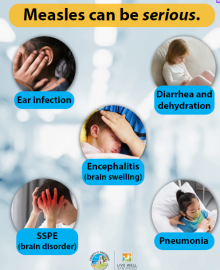
- Severe complications: Pneumonia (infection of the lungs) and encephalitis (swelling of the brain), both of which can lead to hospitalization and may be life-threatening.
- Long-term complications: In very rare cases, measles can lead to a fatal brain disorder called subacute sclerosing panencephalitis (SSPE). This condition usually develops 7-10 years after some, especially a young child, has had measles. It starts with changes in behavior or learning, and then worsens to include muscle spasms, jerking, seizures, loss of coordination, blindness, coma, and eventually death. There is no cure, and treatment only helps manage the symptoms.
Measles can be serious at any age, but the risk of severe illness is highest for:
- Children younger than 5 years of age.
- Pregnant people.
- People with weakened immune systems.
If you think you have been exposed to someone with measles, call your doctor as soon as possible and let them know you have been exposed to someone who has measles. Your doctor can make special arrangements to evaluate you, if needed, without putting other patients and medical office staff at risk.
There is no cure for measles. Treatment is focused on relieving symptoms. Recommendations are rest, adequate nutrition, and fluids. Some people with severe symptoms will need medical care in a hospital.
County of San Diego
- County Notifying People Potentially Exposed to Measles from Out-of-State Traveler (County News Center - March 18, 2026)
- County Urges Measles Vaccination as Cases Rise Nationwide (County News Center - February 5, 2026)
- Measles: Know the Symptoms Poster | Arabic | Dari | Haitian Creole | Pashto | Somali | Spanish
- Measles: What You Need to Know
- Measles, Mumps, and Rubella (MMR) Vaccine
- Measles and International Travel Poster | Arabic | Chinese | Farsi | Korean | Somali | Spanish | Tagalog | Vietnamese
California Department of Public Health
Centers for Disease Control and Prevention
World Health Organization
Suggested Messaging
The increase of measles cases around the country remind us about the importance of vaccination. Measles can cause health complications ranging from ear infections, diarrhea, and dehydration to pneumonia, encephalitis (swelling of the brain), and an untreatable fatal brain disorder called subacute sclerosing panencephalitis (SSPE).
Provide your child with safe and long-lasting protection by making sure they get the measles-mumps-rubella (MMR) vaccine.
Visit sandiegocounty.gov/measles for more information.

Suggested Messaging
Measles is a serious and highly contagious disease.
Know the symptoms: high fever, cough, runny nose, pink eye (red eyes),
tiny white spots inside the mouth (Koplik spots), and a spreading
rash.
If you think you, or your child, has measles, stay
away from others to prevent possible transmission. Call your doctor or
medical provider immediately.
Visit sandiegocounty.gov/measles
for more information.

Suggested Messaging
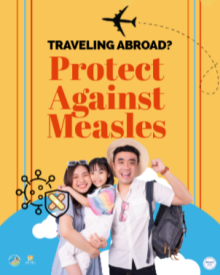
No matter where you are going, make sure you and your loved ones are protected against measles before departure. The best way to protect your family is getting the measles, mumps, and rubella (MMR) vaccine.
Learn more:
www.sandiegocounty.gov/measles

Suggested Messaging
Measles is not is not just a rash. It spreads very easily and can make people very sick, especially babies and young kids. The best way to stop measles is to get the MMR vaccine.
Learn more:
www.sandiegocounty.gov/measles
Suggested Messaging
Prepare for take off! Make sure you are up to date on your measles-mumps-rubella (MMR) vaccines before traveling internationally.
Learn more:
www.sandiegocounty.gov/measles
- Measles Preparedness Checklist for Acute Care Facilities
- Guidance for Care of Suspect Measles Patients
- Guidance for Care of Suspect measles Patients for Dental Providers
- Measles Resources (EZIZ)
- Clinical Overview of Measles (CDC)
- Interim Infection Prevention and Control Recommendations for Measles in Healthcare Settings (CDC)
California Health Alert Network San Diego Communications
- Health Advisory: Update #1: Increasing Measles Activity in California (February 18, 2026)
- Health Advisory: Confirmed Measles Cases in Los Angeles and Orange Counties (February 4, 2026)
Call the Immunization Unit at (866) 358-2966, or send an email, for more information.

 Popular Services