







County of San Diego
Climate Action Progress Annual Report for 2024
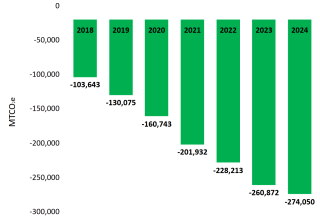
The County reduces greenhouse gas (GHG) emissions through sustainability actions implemented across several County departments. In 2024, the County reduced 274,050 metric tons of carbon dioxide equivalent (MTCO2e)1 of GHG emissions through the implementation of measures from the 2018 Climate Action Plan.
Find status updates on all County GHG reduction measures on the 2018 CAP Dashboard and on our Appendix to the Climate Action Progress Annual Report for 2024.* This Annual Monitoring Report will conclude reporting on the 2018 CAP, which was implemented from 2018 to 2024.
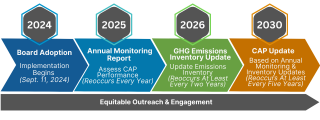
In 2024, the County Board of Supervisors adopted the 2024 Climate Action Plan, a blueprint for reducing GHG emissions in the unincorporated area and at County facilities to reach net zero emissions by 2045. Implementation monitoring of the 2024 CAP will begin in 2025 with annual reports available starting in 2026. To learn more about these efforts and other ways the County is working to ensure a sustainable and just future for our community, visit the 2024 Climate Action Plan website.
1 MTCO2e is the standard unit of measurement for GHG monitoring and evaluation.
274,050 MTCO2e Reduction
2024 County GHG reductions were equivalent to reducing the emissions from 30,837,178 gallons of gasoline!2
The County has continued to make climate action progress and provide co-benefits such as clean air and water, green jobs, and improved public health through implementation of programs and policies within five emissions sectors.

Built Environment & Transportation

Energy

Solid Waste

Water & Wastewater

Agriculture & Conservation
As of 2024, the County achieved 31% of the 2030 reduction target of 897,145 MTCO2e.
County of San Diego
Greenhouse Gas Emissions Reductions
Climate Action Highlights from 2024
83
New EVs Added to the County Fleet
583
Rain Barrels Distributed through the County Watershed Protection Program's Discounted Rain Barrel Program
4,645
Trees Planted by the Department of Parks and Recreation
5,127
Homes Permitted for Residential Solar Power, Over 93% through the County's Online Permits Platform
1,113
Acres of Open Space Preserved through the Multiple Species Conservation Program
Electric Vehicle Roadmap
In October 2019, the County Board of Supervisors adopted the Electric Vehicle (EV) Roadmap, which took significant steps to increase electric vehicle ownership and use, and installing charging stations in the county’s unincorporated area and at County facilities.
The EV Roadmap includes six goals that increase and accelerate electrification of our transportation network in order to reduce GHG emissions and improve air quality in the unincorporated area. Implementation of the EV Roadmap supports the County’s efforts to meet GHG reduction targets and sets the County on a path to meet anticipated future demand for electric vehicle charging infrastructure.
Action + Progress
Since Board adoption, several initiatives to advance EV Roadmap goals have been completed or progressed. Implementation efforts are regularly updated on the EV Roadmap website, and key highlights through 2024 have included:
- Installed 266 EV charging stations at County facilities for fleet vehicles
- Increased the number of in-use EVs in the County’s fleet to 248 vehicles
- Installed 90 publicly accessible EV chargers at County facilities
- Increased teleworking by County employees and reduced more than 6,300 MTCO2e from County employee commutes with teleworking in 2024
- Supported implementation of a Regional Zero Emission Vehicle Strategy as part of the Accelerate to Zero Emissions Regional Collaboration
What to make the switch to an
EV?
The County’s EV
Consumer Guide has the latest information on vehicle market
availability, incentives, and rebates. The U.S. Department of Energy
provides a Vehicle Cost
Calculator to estimate the cost of owning and operating a
vehicle and PlugStar’s
Research a Car provide EV cost calculators based on local
conditions..
Ongoing Electric Vehicle Efforts
The County has multiple ongoing efforts to increase electric vehicle use and access to EV charging infrastructure. These efforts range from increasing the number of EVs used in County operations to regional collaboration to ensure all San Diego county residents have future access to electric vehicles. Some ongoing efforts include the following:
> COUNTY FLEET
GREEN FLEET ACTION PLAN
The County is working to reduce emissions across its fleet operations through the Green Fleet Action Plan. Implemented by the Department of General Services, the plan provides a framework for fleet sustainability by outlining infrastructure needs, fleet reduction strategies, performance targets, and investment requirements to support a zero-emissions fleet. Through 2024, the County has 248 EVs in use, achieving 99% progress towards the EV Roadmap goal of 250 EVs in the County fleet by 2025.
> ELECTRIC VEHICLES
LIBRARY’S BOOKMOBILES
In addition to passenger vehicles, the County has made progress in transitioning County services to zero emission vehicles (ZEVs). The San Diego County Library (SDCL) added four ‘EV Mobile Outreach Platforms’ to provide expanded mobile library services to residents and students throughout the region. These electric outreach vans reduce staff travel emissions, streamline transport of outreach supplies, and build awareness of library services.
> EV INFRASTRUCTURE
CHARGE ON THE GO
The County continued to make progress on the installation of new publicly accessible charging stations in the region in 2024, installing 19 new charging ports across three County locations: the Youth Transition Campus in San Diego, Lindo Lake County Park in Lakeside, and the Ramona Community Resource Center. This brings the total number of installed publicly accessible charging stations to 113, consisting of 102 Level II and 11 fast charging ports.
> COUNTY LEADERSHIP
COUNTY AS A LEADER
In 2024, the County, in coordination with SANDAG, finalized recommendations for the Regional Zero Emission Vehicle Incentive Program (ZEVIP). Funded by a Caltrans Grant, this initiative developed a strategy and implementation plan for future programs that will provide rebates to San Diego residents for purchasing or leasing zero-emission vehicles. Through the ZEVIP, a funding program will facilitate the purchase of new and used zero emission passenger vehicles (such as cars, pickup trucks, minivans) from 2025-2035. This program is a key measure for reducing greenhouse gas emissions outlined in the County’s 2024 CAP.
2024 Climate Action Plan
On September 11, 2024, the County Board of Supervisors adopted the 2024 Climate Action Plan, which establishes 21 measures and 70 actions the County will take to achieve 2030 and 2045 GHG reduction targets and put the County on a path to reaching net zero emissions by 2045 for the unincorporated community and County operations. From preserving open space, agricultural land, and water resources, to promoting solar panel installations, minimizing single occupancy vehicle trips, and supporting carbon storage practices such as tree planting and sustainable agricultural practices, the 2024 CAP employs a range of strategies that were informed through community input to reduce emissions.
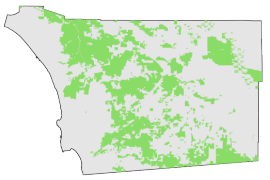
The CAP reduces emissions for the 772,239 acres and over 500,000 residents where the County has land use jurisdiction (in green above) and the approximately 430 County facilities located across 19 jurisdictions.
Advancing Equity and Environmental Justice
The 2024 CAP prioritizes climate actions in frontline communities that experience the most immediate and worst impacts of climate change, such as low-income communities. Through its implementation, the 2024 CAP will strive to achieve equity-based outcomes and community co-benefits throughout the unincorporated area. These benefits include improved community health, cleaner air and water, increasing sidewalks and bike lanes, promotion of a green economy, and improved neighborhood resilience, among others.
To further integrate equity, CAP implementation will be supported by an Equity Implementation Framework that provides step-by-step guidance to ensure climate action, investments, and outcomes are prioritized equitably while avoiding unintended consequences in frontline communities.
Implementation and Monitoring
The County will monitor 2024 CAP implementation annually to assess the effectiveness of each measure and action, update the emissions inventory at least every two years, and adjust as needed through CAP updates at least every 5 years to stay on track towards meeting reduction targets.
Visit our project website and follow us on Facebook, Instagram, and X to learn more and get involved in the process!
Sustainability Initiatives at the County of
San Diego
In 2024, the County continued to take bold action towards addressing the climate emergency through a variety of sustainable, equitable policy directives.
Collaborating to Reach Zero Carbon
- Held 7 Community Climate Conversations with community partners across the region to share insights and help shape a stronger, more connected, resilient future.
- San Diego Community Power and the County established the San Diego Regional Energy Network, which will bring $124m to the region for programs that empower communities to embrace clean energy solutions and contribute to regional climate goals.
Principles for sustainable development
- Identifies principles of sustainable development and integrates smart growth concepts to inform future land use decisions.
- Visit the engagement portal to keep up to date on the status, outreach events, and more.
Increasing use of native plants in landscaping
- Offers training, resources, and incentives to increase the use of native plants in landscaped areas to support biodiversity.
- Released a new program website to provide program updates, milestones, and resources.
Sustainability in our operations
- All County departments and offices (40+) have sustainability commitments to outline commitments that improve sustainability outcomes for County operations to lead to a just, sustainable, and resilient future for all.
- Releasing Departmental Sustainability 2024 Annual Report during Summer 2025.
Dedicated climate equity resources
- Established the Environmental Justice Workgroup of community members to inform equitable approaches for the development and implementation of County and other local jurisdictions’ climate efforts.
- Released the Food Justice Community Action Plan, which translates community ideas into a roadmap to drive collaborative change, improve food access, and reduce food insecurity in the region.
Stay Connected
For questions and media inquiries, contact us.
Check out previously published annual monitoring reports.
*These documents are provided for reference only and any posted before 04/26/27 may not meet current ADA accessibility standards. If you need this information in an accessible format, please contact us at CAP@sdcounty.ca.gov.


 Climate Action Links