




Data on Older Adults
The term “older adult” is typically defined in two different ways. In some publications, an older adult may be considered as 65 years and older, more closely aligning to the age for retirement and eligibility for full Social Security retirement benefits. Alternatively, from a programmatic standpoint, at age 60, a person is eligible to receive services through the federally funded Older Americans Act (OAA). In the County of San Diego, when considering older adults, health data are typically analyzed for the 60 and older age group, while demographic data from the Census include those 65 and older.
The population 65 years and older is rapidly growing across the U.S. and locally in San Diego County. From 2010 to 2020, the number of people in the older population in the U.S. increased by 15.5 million people, the largest 10-year numeric increase to date.1 According to the Census, the spike is due to the baby-boomer generation aging into the 65 and over age group. Further, with age, the risk of chronic diseases like dementia, heart disease, type 2 diabetes, arthritis, and cancer increase.2 As of the 2020 Census, 16.8% of the US population was 65 years and older, but by 2060, older adults are estimated to account for nearly a quarter of the U.S. population.1,2
Below is a compiled listing of data related to the health and well-being of our aging population in San Diego County. If you are looking for resources or more information, please refer to the County of San Diego's Aging and Independence Services.
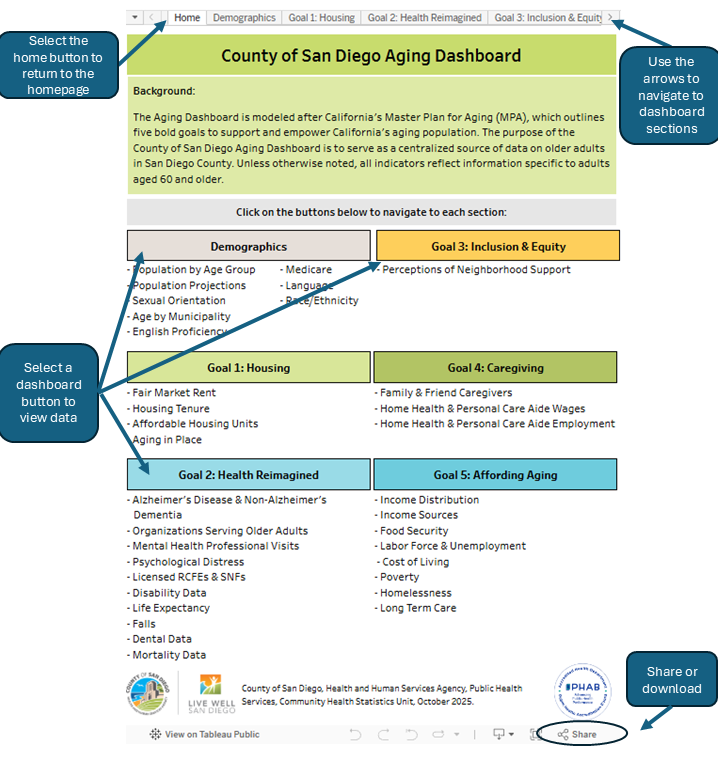
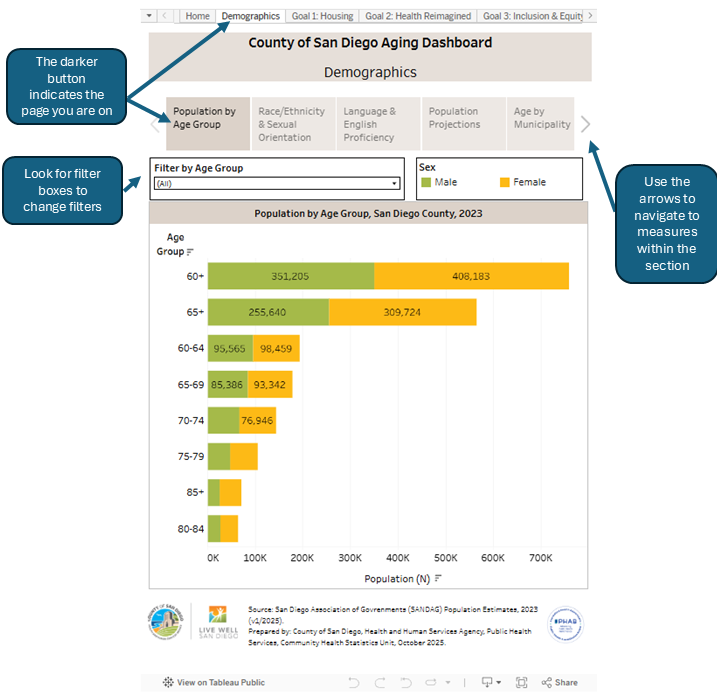
The Aging Dashboard serves as a centralized data resource for San Diego County’s older adult population. Modeled after California’s Master Plan for Aging (MPA), the dashboard includes more than 50 metrics framed within five primary goals: demographics, housing, health, inclusion and equity, caregiving, and affordability. Metric selection, while following the MPA framework, expands beyond those outlined in California’s model to reflect the local San Diego County older adult needs and demographics.
All data, unless otherwise specified, is specific to older adults aged 60 or 65 years and older. Notable measures include Alzheimer’s Disease and Non-Alzheimer’s Dementia prevalence and projections, Medicare enrollment demographics, health outcomes and mortality, aging in place metrics, affordable housing units, and food security.
Visit How to Use the Aging Dashboard to learn how to use the dashboard.
Older Adult Health in San Diego County
This report examines notable health outcomes among the older adult population, including chronic and communicable (infectious) diseases, behavioral conditions, and injuries. With special emphasis on Alzheimer’s disease and non-Alzheimer’s dementia, this report estimates the number of older adults living with Alzheimer’s disease and non-Alzheimer’s dementia and gives projections through 2050.
Associated risk factors for dementia and other chronic conditions, including physical inactivity, smoking, alcohol use, and access to care are explored. Further, social and economic factors particularly relevant to the older adult population are described, such as loneliness and isolation, poverty, and homelessness.
Older Adult Health in San Diego County
Report
Alzheimer’s Disease and Non-Alzheimer’s Dementia Fact Sheet
This fact sheet presents current prevalence estimates of Alzheimer’s disease and non-Alzheimer's dementia among adults aged 65 and older in San Diego County and provides projections through 2050. The prevalence estimates are presented by demographic, including age group, race/ethnicity, and sex. The burden and costs of unpaid caregivers are highlighted. Risk factors for chronic disease, including Alzheimer’s disease and non-Alzheimer's dementia, are outlined.
Alzheimer’s Disease and Non-Alzheimer’s Dementia in San Diego County Fact Sheet
Demographic Profiles - Older Adult Subsets
The Demographic Older Adult Profiles are subset of the larger demographic profiles document for San Diego County. This profile set reflects data covering demographic and economic data on seniors available by HHSA Region and community, municipalities and the unincorporated area, and Supervisorial District.
-
Demographic Profiles - Older Adult Subsets
2023 Demographic Profiles: Older Adult Subsets
2022 Demographic Profiles: Older Adult Subsets
2021 Demographic Profiles: Older Adult Subsets
2020 Demographic Profiles: Older Adult Subsets
2019 Demographic Profiles: Older Adult Subsets
Leading Health Conditions Among Older Adults Briefs
The Leading Health Conditions Among Older Adults briefs identify the leading health conditions impacting older adults in San Diego County. Cases and rates are presented by age group or geographical area within the three reports below.
- Leading Health Conditions Among Older Adults in San Diego County, 2024 Cases and rates are presented for older adults aged 60 years and over and by age group for those 60-69, 70-79, and 80 years and older in 2024.
- Leading Health Conditions Among Older Adults in San Diego County by Health and Human Services Agency Region, 2024 Cases and rates are presented for older adults aged 60 years and over in Central Region, East Region, North Central Region, North Coastal Region, North Inland Region, and South Region in 2024.
- Leading Health Conditions Among Older Adults in San Diego County by Supervisorial District, 2024 Cases and rates are presented for older adults aged 60 years and over in each of the five Supervisorial Districts in 2024.
Please click "expand all" or click anywhere in the bar below to open it and access the links for prior years of the Leading Health Conditions for Older Adult Briefs.
-
Leading Health Conditions Among Older Adults Briefs
Previous:
The Leading Health Conditions Impacting Older Adults briefs identify the leading health conditions impacting older adults in San Diego County. Cases and rates are presented by age group or geographical area within the three reports below.
Leading Health Conditions Among Older Adults in San Diego County, 2023
Cases and rates are presented for older adults aged 60 years and over and by age group for those 60-69, 70-79, and 80 years and older in 2023.
Cases and rates are presented for older adults aged 60 years and over in Central Region, East Region, North Central Region, North Coastal Region, North Inland Region, and South Region in 2023.
Leading Health Conditions Among Older Adults in San Diego County by Supervisorial District, 2023
Cases and rates are presented for older adults aged 60 years and over in each of the five Supervisorial Districts in 2023.
Archive:
- Leading Health Conditions Among Older Adults, 2021 - This brief document identifies leading health conditions impacting older adults 60 years and over in San Diego County. Cases and rates are presented for older adults age 60 years and over and by age group for those 60-69, 70-79, and 80 years and older in 2021.
- Leading Health Conditions Among Seniors, 2019 - This brief one page document identifies leading health conditions impacting seniors over the age of 65. Cases and rates are presented for 2019.
Cost of Living for Older Adults
Cost of living can vary by age. The cost of living tool below helps to highlight the economic issues faced by the aging population in San Diego County. It helps determine the basic costs of living for older adults (those aged 65 years and over) and to visualize the amount spent on basic necessities for older adults in each Health and Human Services Agency (HHSA) region, subregional area (SRA), and San Diego County overall. Select household composition, housing tenure, and geography to explore the differences in the expenditure on basic necessities. The briefs provide background information and key findings from the data included in the dashboard.
Cost of Living for Older Adults, San Diego County, 2025 Brief
See the below image to learn how to use the Cost of Living for Older Adults Dashboard:

1 Caplan and Rabe. (May 2023). The Older Population: 2020. 2020 Census Briefs. Accessed 12/5/2024. https://www.census.gov/library/publications/2023/decennial/c2020br-07.html
2 Center for Disease Control and Prevention (CDC). (June 2024). Older Adults. Accessed 12/5/2024. https://www.cdc.gov/cdi/indicator-definitions/older-adults.html


 Popular Services